

Perspectives And Insights
Company news, events, and leadership perspectives from the board rooms driving enterprise AI transformation.
Career Leaders Win the Initiative. Legacy Leaders Build the Future. Part Three: The Legacy Map
At A Glance: Key Takeaways for Leaders
- The Core Distinction: While career-minded leaders often optimize for shorter term initiative success, legacy leaders focus on building durable enterprise adaptability.
- The “Legacy Map” Framework: Rather than approaching AI execution as a single transit line with disconnected, linear stops, legacy leaders establish an interconnected network for multi-dimensional growth.
- Overcoming Transformation Traps: Enterprise transformation stalls when initiatives or tools are deployed as isolated use cases without updating the underlying organizational foundations.
- The Strategic Bottom Line: Effective legacy leadership requires investing in foundational capabilities that successors can inherit, expand, and leverage for durable competitive advantage.
This series was originally published on LinkedIn by ESG’s Enterprise AI Practice Leader, Richard Steele. Find it here.
A few years ago, the first version of OpenAI’s ChatGPT was publicly released. Companies clambered, trying to understand the new technology and its implications across industries. Executives began to call, including one of our leading clients. They wanted to know if this should be taken seriously. If AI needed to be a priority or an impending investment. The board was asking questions. Their teams were panicking. They wanted to know if they would need to take a stance on AI, and how. Given our practical backgrounds navigating large-scale enterprise transformations, we knew this was the beginning of a monumental shift. But none of these questions had easy answers yet. And no one could have anticipated the velocity at which AI would evolve.
For the past three years, that’s been the underlying choice beneath almost every leadership decision about AI, whether anyone wants to name it or not: optimize for the initiative in front of you, or build the organization that outlasts it. Before AI, most leaders didn’t need to consciously choose between those two things.
Today, I like to think of this choice as a map. Specifically, a subway map.
The Subway Lines
Most career leaders I’ve worked alongside can draw you their line. It has clear start and end stops, with punctuated milestones in between: strategy approved, pilot launched, tool adopted, benefit realized. There’s nothing wrong with building like this. In previous workforces, it’s how almost every leader was measured, promoted, and held accountable.
Part of why this pattern persists is structural. No centralized function can watch what’s happening at the workflow level closely enough to catch problems while they’re still small. By the time the gap surfaces in a status report, the resistance is already baked in and the relationship between technology teams and the business has already become strained. The visibility gap doesn’t just persist at scale. It compounds.
Neither outcome was caused by bad judgment. The traction trap (mistaking action items for transformation) wasn’t caused by bad metrics. The visibility gap (invisible, accumulating problems) wasn’t caused by weak change management. Both emerged because leaders optimized for success during their own tenure rather than the organization’s capacity after it. Different symptoms. Same root choice.
That’s the real difference between a career win and a legacy win. A career win shows up on your performance review. A legacy win shows up on someone else’s, years after your name has left the org chart.
What Legacy Leadership Actually Builds
Career leaders deliver AI initiatives. Legacy leaders build organizations that can absorb the next initiative without starting over.
That distinction sounds subtle until you watch it compound. A career leader funds the effort, the platform goes live, the metrics get reported, and the next initiative starts from the same blind spots as the first because nothing underneath it changed.
A legacy leader builds something harder to see and harder to justify in a quarterly update: the capacity for adaptive, durable, future growth. The traditional change management model assumed a single sponsor, a linear timeline, and a clean progression from decision to rollout. AI transformation doesn’t work that way. It requires proactive building before the pressure arrives, and that is precisely where career-focused leaders strain to shift.
Enterprise leaders navigating this have to think like city planners. And every city planner eventually runs into the same problem at a different scale.
A growing city needs public transit between its residential neighborhoods and the commercial center. The obvious answer is to extend the existing subway line: one corridor, one project, one clear victory at a time before the next election. The extension is visible and solves a problem constituents can name today.
But growth projections tell a different story. Outlying areas are developing. Housing demands are rising. Commuting patterns are shifting. The need for transit coverage in those areas is emerging now, even if the demand won’t peak for years. Building the single extension can start immediately. But planning, approvals, and funding for the broader network cannot happen with the current resources available, not on the existing timeline.
The city planner who chooses the network vision accepts that the extended line likely won’t break ground before their next election. The long-term pain points won’t be addressed by the current administration. There will be criticism for delaying the obvious fix in favor of a more comprehensive plan the city won’t see for years. The planner builds something the next administration will open, and the one after that will rely on, all without attending the grand opening themselves.
Introducing “The Legacy Map”
That’s the legacy map. More than a single, immediate line from here to there. A network designed for where the city is going and what it needs to stay successful in the future, not just where it hurts today.
The London Underground’s Elizabeth line is the clearest real-world example I know of this pattern at scale. The concept was first proposed in 1919. Parliamentary approval didn’t come until 2008. The line opened in 2022. Every leader who championed it in its early decades was gone before a single passenger rode it. They built it anyway, because the city they were planning for wasn’t the city that existed yet. The result is now one of the most important transit corridors in Europe, and it exists specifically because someone kept planning for growth that hadn’t arrived. The full history is worth reading.
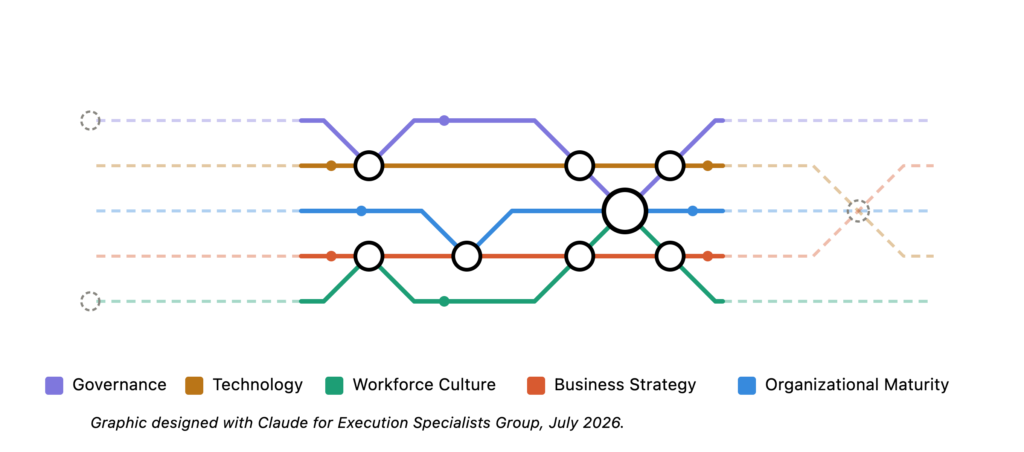
Most organizations building AI capability are drawing a single line and calling it a strategy. The immediate pain gets addressed. The metrics improve. Then the growth arrives from directions the single line was never built to reach, and there’s no network to connect it.
Technology enables. Culture activates. But culture doesn’t activate by default. It unfolds through the decisions made before the pressure to break ground makes those choices for you. That’s what intent means in this context. Not a value statement. A planning posture.
The Map You’ll Never See Completed
We’ve seen this play out in real time. Three years into working with a client, the results of legacy-centered leadership have become visible. The CEO made a different decision. The executives bought in and began building. The people in the room have changed. The questions being asked are evolving. The organization is developing a fundamentally different approach with its clients. The organization is successfully adapting.
This shift didn’t happen because of a single new platform or targeted implementation. It happened because intentional, foundational work made it possible. A career leader running the same program would have reported early achievements and moved on. There wouldn’t have been a path to bigger changes. But this client led with legacy in mind, creating a roadmap that didn’t exist before.
Most enterprise AI strategy is being built by leaders who may not be in the role long enough to see the whole subway network expand. That’s not a criticism. It’s the honest shape of how careers and tenures actually work. The question worth asking isn’t whether you’ll be there when it does. It’s whether you’re building something worth riding at all.
Career leadership and legacy leadership aren’t in conflict. You can do both. But only one of them compounds past your own tenure. Your successors may not remember the line you finished. They will build on the map you leave them.
When your successor inherits the organization, what will its people be capable of because of you?
Missed part of the Foundationally Human series? Read Part One: The Traction Trap and Part Two: The Visibility Gap, for more on AI and long-term enterprise transformation.
About the Author
Richard Steele is the Enterprise AI Practice Leader at Execution Specialists Group (ESG), orchestrating enterprise AI strategy, digital transformation, and organizational change management. He advises C-suite executives on identifying enterprise strengths and maturity opportunities and establishing durable operational capabilities, supporting organizations as they transition from isolated pilots to realize sustainable value.