

Perspectives And Insights
Company news, events, and leadership perspectives from the board rooms driving enterprise AI transformation.
Technology Gets the Credit. OCM Gets the Blame. Part Two: The Visibility Gap
At A Glance: Key Takeaways for Leaders
- The Core Distinction: Effective Organizational Change Management (OCM) for AI transformation isn’t a linear, isolated process but a complex system of capabilities simultaneously interacting with workflows across different stages of deployment and workforce readiness.
- Navigating the “Visibility Gap”: Traditional status reporting creates blind spots where workflow friction, resistance, and operational workarounds invisibly accumulate beneath high-level “success” metrics.
- Organizational Change Management (OCM) in the era of AI: Distributing change leadership across enterprise teams requires foundational conditions including long-term vision, adaptable governance, and readiness infrastructure to prevent spreading organizational dysfunction.
- The Strategic Bottom Line: Leaders who invest in foundational organizational capabilities establish a durable change ecosystem that aligns business and technology initiatives with coordinated OCM execution.
This series was originally published on LinkedIn by ESG’s Enterprise AI Practice Leader, Richard Steele. Find it here.
Not long ago, our team was brought in to assess the aftermath of a portfolio management platform implementation that had gone sideways. Technically, the deployment was complete. The system was live. By every project management measure, the work was done.
The problem wasn’t a technology issue. It was a people issue. Almost no one was using it the way it was designed to be used. Workflows that were supposed to change hadn’t. Adoption was inconsistent at best. As a result, the relationship between the technology team and the business it supported had become increasingly strained.
Our evaluation surfaced a familiar pattern. The technology team had assessed the change as relatively straightforward. New platform, updated processes, some training. What they hadn’t seen, because no one had given them a clear view of it, was the operational complexity sitting underneath the surface. The people expected to navigate the change were working inside a web of informal workarounds, undocumented dependencies, and longstanding process habits that the new system had disrupted.
What looked simple from the deployment side was overwhelmingly complicated from the receiving side.
Organizational Change Management (OCM) had been brought in late, scoped narrowly, and handed a communication plan to execute. When the implementation struggled, the blame turned quickly to ineffective change management. The training wasn’t sufficient. The communications missed the mark. The people side of the project hadn’t been handled well enough.
Some of that was fair. Most of it missed the core issue entirely.
The real failure wasn’t in the change management execution. It was in the structural position OCM had been given from the start. Brought in after the technical decisions were made, handed a plan rather than a seat at the table, OCM had no mechanism to surface what it couldn’t see. The gap between what the technology team understood about the change and what the business actually experienced was a visibility problem.
This isn’t a new blame game. I’ve watched this dynamic play out enough times to recognize it as a predictable pattern rather than a series of unfortunate coincidences. The technology gets the credit when it works. OCM gets the blame when it doesn’t. AI amplifies the cycle, pressuring organizations to sprint forward without a clear remediation strategy.
OCM: A Framework Built for a Different Era
Traditional OCM was designed for a world where linear change arrived from the outside. A new system was selected, a project was scoped, and change management was deployed to help people adapt. The model assumed a clean separation between the technology being implemented and the people receiving it. Change had edges. OCM could see them, prepare for them, and manage the transition from current state to future state with reasonable, well-honed confidence.
AI challenges all of this. Research consistently shows employees are already using unauthorized AI tools regardless of policy. When a traditional platform rollout goes sideways, the impact is typically straightforward, visible, and contained. When an AI or agentic rollout lacks sufficient people-centered change management, Shadow AI spreads. Unapproved tools. Untracked data exposure. Unsanctioned and unmonitored model behavior.
The risk profile isn’t just different in degree. It’s functionally different.
That risk gap exists because AI isn’t being added to an existing hybrid human + digital workforce. AI is the force creating one. Most organizations haven’t operated a hybrid workforce before. The concept itself is still alien to the majority of leaders and employees navigating it in real time. There are no established playbooks, no shared reference points, no institutional memory of what success looks like on the other side. The destination and the journey are being mapped while being traveled.
That will change, but we’re not there yet. Right now, organizations are being asked to drive unprecedented transformation while simultaneously inventing it, at a pace that makes the traditional approach to OCM insufficient.
The scope of what’s actually changing makes that challenge more complex than most leaders have dealt with. Process redesign. Governance frameworks. New roles and disappearing ones. New tools with new risks. Retraining that has to happen before the workflows change, not after. And underneath all of it, a workforce trying to make sense of what their work even means in an environment that keeps shifting.
The go-live is no longer the end goal, it’s just the ribbon cutting. The real question is whether people change how they work when nobody is watching…three months later.
Introducing “The Visibility Gap”
OCM, positioned as a downstream function, can’t identify the complexity of what happens at the workflow level until after the deployment exposes it. By then, the damage is done and the recovery is harder than the original change would have been.
Now, scale that problem across an entire enterprise AI transformation. The complexity isn’t in one system and set of workflows. It’s in the complex web of AI capabilities interacting with hundreds of workflows simultaneously, at different stages of deployment, with varying levels of workforce readiness across the organization. The visibility problem with AI doesn’t just persist at scale. It compounds. The result is what I’ve started calling the “visibility gap.”
When OCM is a centralized function or a project role, what’s happening at the workflow level depends entirely on what gets escalated. In a traditional change event, that lag is manageable. There’s enough time between the decision to change and the change taking effect to identify gaps, adjust plans, and course correct before the deployment.
In an AI transformation where change is happening faster than reporting cycles can capture it, lag becomes a structural blind spot. By the time OCM sees the problem, the pattern is already established. The resistance is already baked in. The relationship between technology teams and business units has already started to strain in exactly the way it did in the portfolio management implementation example, only now across the entire organization at once.
This is why the visibility gap allows the traction trap to persist even when organizations know it exists.
A Different Architecture for a Different Problem
Effective OCM for AI transformation doesn’t look like a single centralized function managing a communication plan. It looks like a network. An ecosystem. Enterprise-level guidance and direction set the strategic frame. Project-level OCM manages the specific change events inside individual initiatives. Department-level messaging and local champions translate the strategy into the employees’ reality.
Communities of Practice and Centers of Excellence connect the layers, moving insights up and guidelines down. That network doesn’t eliminate the need for centralized coordination. It makes centralized coordination meaningful by connecting it to what’s actually happening on the ground.
Conceptually, an effective OCM ecosystem for the AI era might look something like this:
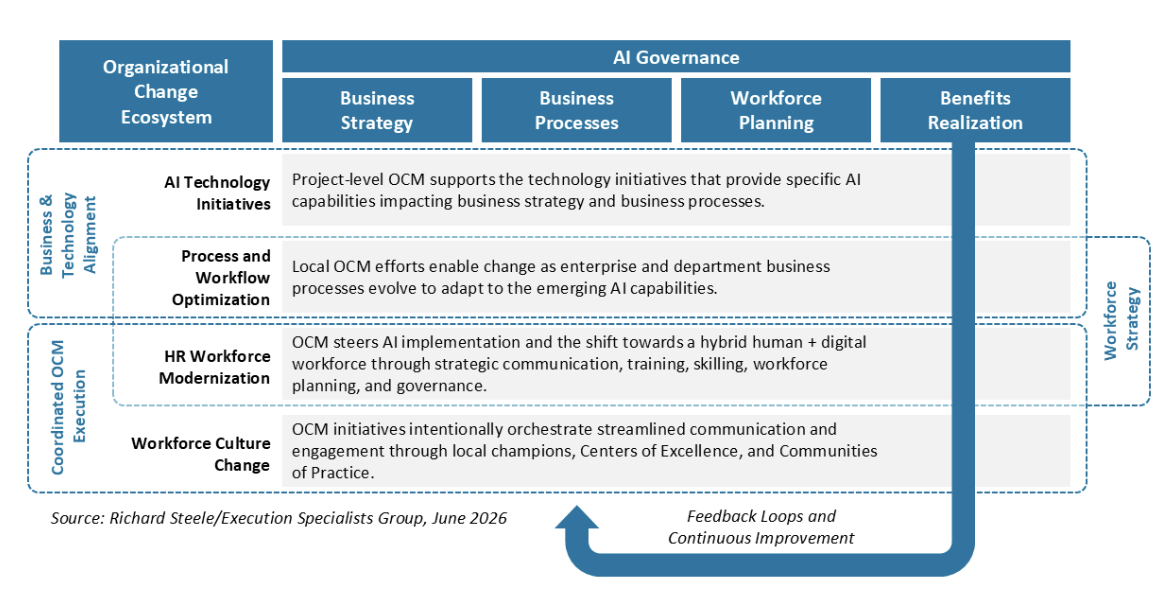
Technology enables. Culture activates. The activation doesn’t happen immediately. It happens in the watercooler conversations between a supported local champion and a skeptical colleague on a Tuesday afternoon when nobody from the program team is in the room.
Building that kind of distributed change capability requires leaders at every level to carry some version of change leadership as a core responsibility, rather than viewing it as something they hand off to a specialist when the project kicks off. It requires the people closest to the work to have both the language and the authority to surface what’s actually happening when AI lands in their workflows. And it requires a governance structure that creates visibility across the full scope of what’s changing, not just the parts that made it onto the project plan.
Distributing OCM across the organization is necessary, but not sufficient. It only works if the foundational conditions exist first. If leadership isn’t aligned on the long term transformation vision, adaptable, AI-ready governance, or the organizational readiness infrastructure that makes distributed change leadership possible, distributing OCM just distributes the dysfunction.
Most organizations are skipping these foundational pieces. Yet, these determine whether the leaders navigating this transformation are remembered for the productivity gains they’ve reported, or the organizational capability they’ve actually built.
Missed Part One: The Traction Trap? Find it here.
See Part Three: The Legacy Map here.
About the Author
Richard Steele is the Enterprise AI Practice Leader at Execution Specialists Group (ESG), orchestrating enterprise AI strategy, digital transformation, and organizational change management. He advises C-suite executives on identifying enterprise strengths and maturity opportunities and establishing durable operational capabilities, supporting organizations as they transition from isolated pilots to realize sustainable value.